
Flexibility Is Not Resilience
A clearer distinction may help us think more carefully about what modern power systems are being asked to do

What bends easily is not always what endures well.
Introduction
Flexibility has become one of the defining virtues of the energy transition. The term now sits at the centre of discussions about batteries, demand response, renewable integration, ramping capability, and smarter markets. In many ways that makes sense. A more decentralised, weather-exposed system does need to be flexible.
Yet the rise of flexibility may also be blurring something important. Flexibility is not the same as resilience. The two can overlap, but they do not answer the same question. A system may be quick to respond and still struggle to hold its shape through a sustained period of stress.
That distinction matters more as the transition deepens. What happens when a term that explains part of the challenge starts to stand in for the whole? And what becomes visible once resilience is treated as a distinct concern rather than an assumed by-product?

Why flexibility became so central
The ideas we repeat most easily are often the ones that travel furthest.
Flexibility became central because it captures something power systems genuinely need. Renewable-heavy grids must respond to changing supply patterns, sharper operational variation, and a more active edge of system.
That helps explain its appeal:
It speaks to immediate operational needs: modern grids need assets that can ramp, react, and adapt quickly.
It fits contemporary technologies well: batteries, smart demand, and digital controls all lend themselves to the language of responsiveness.
It travels easily across policy and markets: flexibility sounds practical, modern, and broadly useful.
None of this should be dismissed. Flexibility has earned its place. But once a term becomes dominant, it can also begin to hide what it does not fully describe. That is where the distinction becomes useful.
What flexibility explains well
A good concept deserves credit before it is given limits.
Flexibility is not an empty slogan. It points to real and valuable capabilities that systems increasingly rely upon.
At its strongest, it helps us see the value of short-timeframe response:
It helps manage variability: changing renewable output and shifting demand can be handled more smoothly when response is quick.
It supports operational stability: fast-acting resources can assist with balancing, ramping, and contingency management.
It creates room for cleaner integration: flexible assets can help systems accommodate more renewable generation.
These are important gains. The issue is not that flexibility is unhelpful. It is that its strengths can be mistaken for a complete account of resilience.
What resilience asks that flexibility does not
Response is about the next move. Resilience is about the whole run.
Resilience introduces a different set of concerns. It asks not only whether a system can react, but whether it can remain effective through difficult sequences, recover after depletion, and preserve enough depth when conditions turn against it.
That brings another layer into view:
Resilience is concerned with endurance: not only whether the system responds now, but whether enough useful capability remains later.
Resilience includes recovery: a resource may perform well initially but still leave the system weakened if restoration is slow, costly, or weather-dependent.
Resilience is shaped by sequence: a string of manageable conditions can become difficult when they arrive in the wrong order.
This is the heart of the distinction. Flexibility may be necessary. It is not necessarily sufficient.
Why the confusion matters
The words we merge too quickly can blur the risks we most need to see.
Treating flexibility and resilience as though they are effectively interchangeable can distort judgement. It can create comfort in the presence of fast-moving assets without asking whether those assets provide enough staying power under stress.
Several consequences follow from that confusion:
It can reward visible agility over quieter depth: fast response is easy to see and easy to value, while endurance often becomes visible only when it is missing.
It can flatten different forms of adequacy into one: managing short-run variation is not the same as riding through prolonged strain.
It can narrow public understanding of security: a system can appear agile and modern while carrying a hidden dependence on timely replenishment or favourable conditions.
That last point matters most. Once resilience is reduced to flexibility, systems can look safer than they are. Language itself starts to conceal the gap between responsiveness and staying power.
What battery episodes help reveal
Sometimes a local event clarifies a wider concept.
Recent observations from South Australia help illustrate why this distinction matters. A battery fleet can appear responsive, commercially active, and technically valuable, yet still end up with low aggregate reserves after a difficult sequence of weak wind and solar. The lesson is not that batteries are unhelpful. It is that their contribution should not be reduced to a shorthand for resilience.
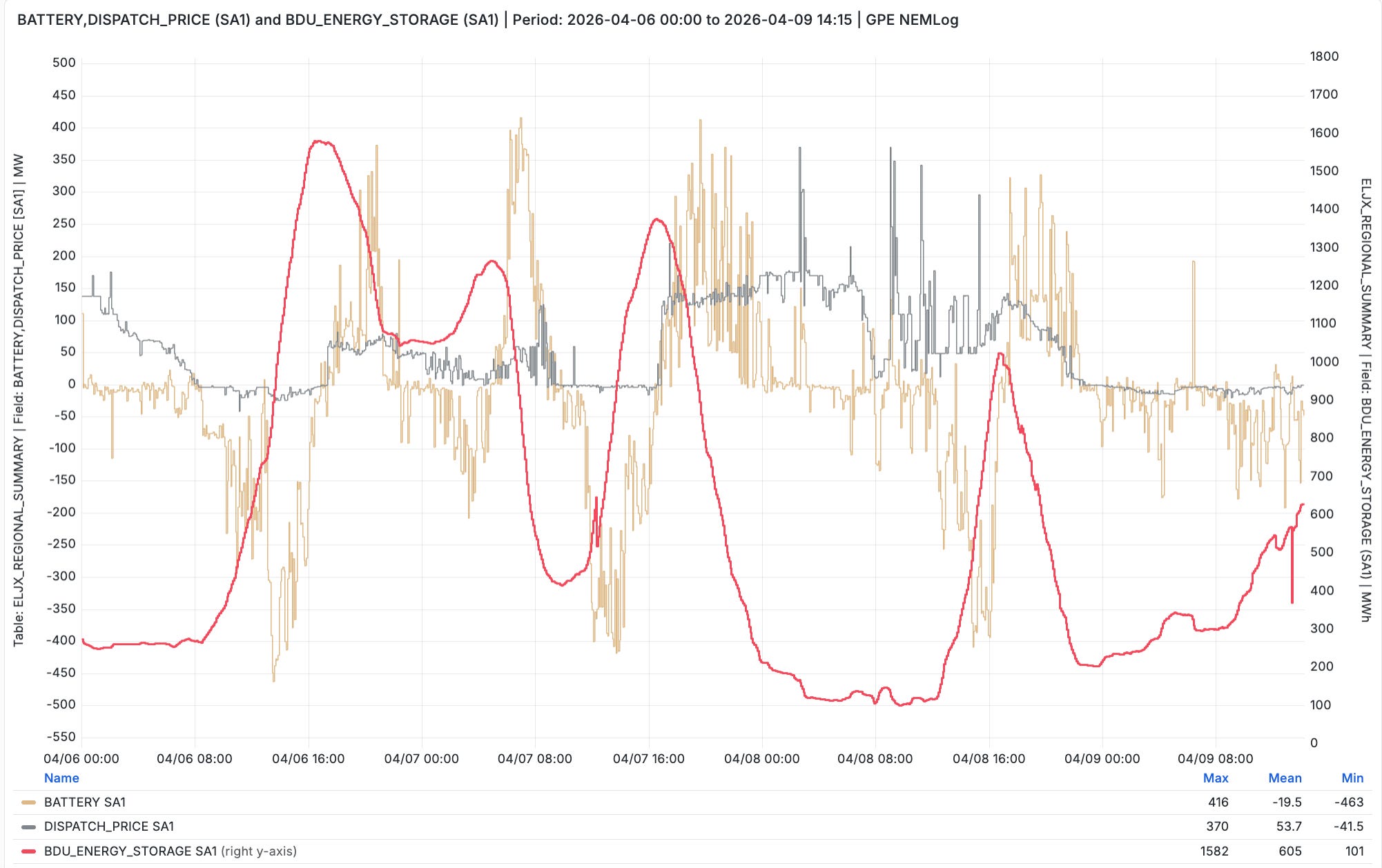
Chart Note: Flexibility in motion, resilience under pressure. South Australia’s aggregate battery storage responds actively to price signals from 6–9 April 2026, but the sharp drawdown and slow recovery on 7–8 April point to a difference between rapid response and sustained reserve depth.
That episode sharpens the broader point:
Flexibility is visible in how quickly batteries can move: they charge, discharge, and respond effectively to market and system conditions.
Resilience is tested by what remains after that movement: low aggregate state of charge raises a different question about depth and endurance.
The system lesson lies in the gap between the two: response capability does not automatically guarantee protected optionality through the next difficult stretch.
This does not close the debate. It does help locate it more clearly.
Towards a better vocabulary
Clearer language can make deeper problems easier to notice.
One reason this distinction matters is that it suggests the need for a richer vocabulary. Flexibility remains useful. It just may need company.
A fuller discussion might spend more time on:
Endurance: how long useful capability can be sustained under strain.
Reserve depth: how much optionality remains after the first difficult period has passed.
Recovery conditions: what must be true for depleted resources to become strategically useful again.
These ideas do not replace flexibility. They help specify dimensions that flexibility alone can leave too vague. Once named, they become easier to plan for and discuss.
Conclusion
The transition does need flexibility. It needs assets and systems that can adapt, respond quickly, and integrate a more variable resource base. But the increasing complexity of modern grids suggests that flexibility should be treated as one part of the picture, not the whole of it.
Resilience asks harder questions. It asks what remains after the first response, what can recover after depletion, and what kind of system shape is preserved when conditions are awkward rather than ideal. That makes it less immediate as a slogan, but arguably more useful as a guide.
The grid of the future may be admired for its flexibility, but it will be judged by its resilience.