
The Saint and the Missing Tile
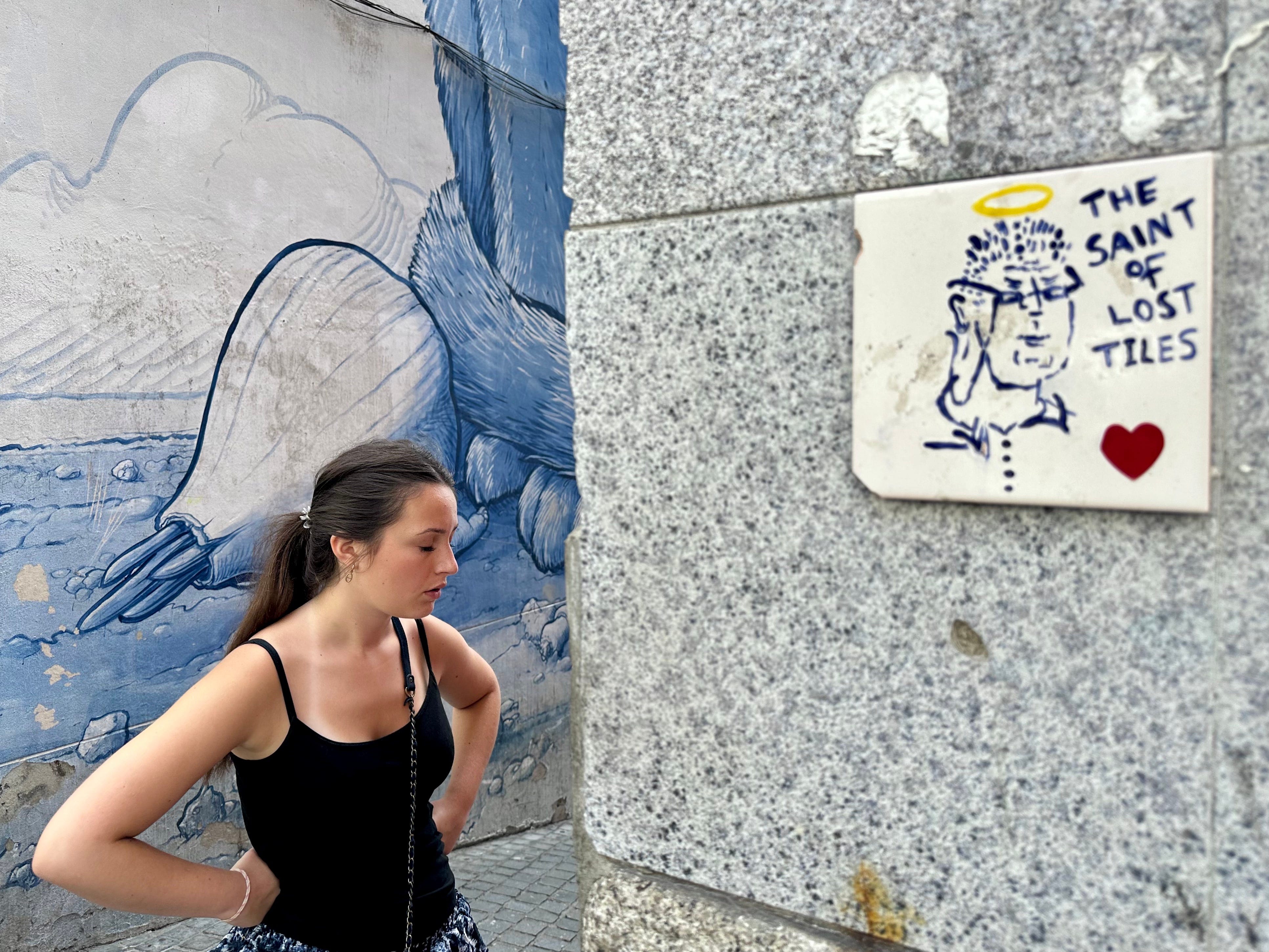
A whimsical guardian watches over Porto’s absent treasures beneath the gaze of a giant blue cat.

"The Saint of Lost Tiles"
— Unknown artist, R. das Flores, Porto (Fri 08 Aug 2025)
Summary
In Porto, a saintly tile honours what is gone, a passer-by contemplates its charm, and above them looms a colossal blue cat, dangling garlic like a talisman over the street.
Explanation
Porto’s azulejos are more than decoration—they are the city’s memory pressed into clay. Yet many vanish over time, leaving silent scars on its walls. On one such patch of granite, a small tile appears: a cartoonish, haloed “Saint of Lost Tiles,” its hand-drawn style and small red heart turning loss into affectionate satire. The faint adhesive marks around it are more than background—they are archaeological proof of an actual missing tile, making the saint’s presence both literal and symbolic.
A young woman stands before it, caught in a moment of quiet attention. She becomes part of the scene, the living witness who bridges the city’s heritage and its street art. But here, the story does not end at eye level.
Above, spanning the height of an entire building, a vast mural reveals itself (we will reveal it in the next post): a deep blue cat with golden eyes, painted with surreal precision, holding in its paw a dangling garlic bulb and sprouting flower. This monumental feline watches silently over the street, transforming the small saint below into part of a much larger visual conversation—between the delicate, the absurd, and the monumental.
The pairing feels quintessentially Porto: heritage meeting humour, the minute details of loss anchored beneath grand, playful spectacle. The alley becomes a layered artwork in itself—every element part of the same ongoing tale.
About the Artist
The small saint remains anonymous; the cat mural, a separate work, bears the hallmarks of Porto’s large-scale urban art scene, where international and Portuguese artists alike leave their mark on the city’s vertical canvases. Together, they form an accidental collaboration, one tiny and intimate, the other vast and commanding, both testifying to Porto’s instinct for making the street itself a gallery.
An After Afterthought
“One minute, I held the key
Next the walls were closed on me”
— Viva la Vida, Coldplay (2008)
The Saint of Lost Tiles could speak those words — a tiny guardian for what has slipped from the walls, keeping vigil in a city that constantly remakes itself. Here, the ruin is only the space left behind, but the lesson is the same: to walk Porto’s streets is to see its history not as a fixed picture, but as a mosaic that is always being rearranged.
About the Song and Group
Released in 2008 on the album Viva la Vida or Death and All His Friends, the track became one of Coldplay’s most iconic hits, known for its orchestral arrangement and reflective, rise-and-fall narrative. Coldplay, formed in London in 1996, are celebrated for blending anthemic rock with lyrical introspection, often weaving themes of hope, loss, and renewal into their music.